Industrial buyers rarely pick up the phone first. Engineers, procurement teams and project managers usually research suppliers online, compare a shortlist, and only get in touch once they are fairly sure you can do the job. By the time they contact you, your website has already done much of the selling — or quietly removed you from the list.
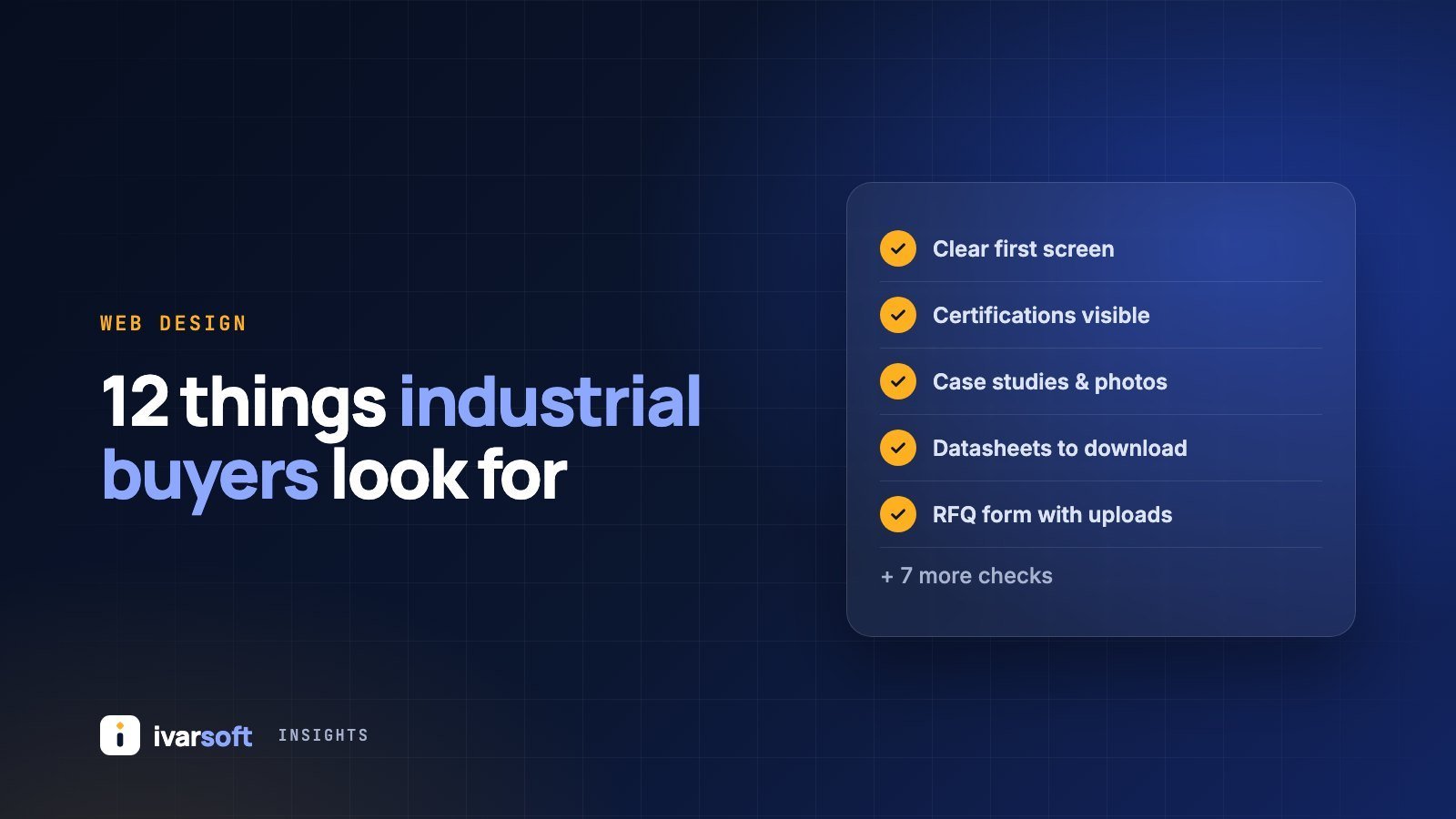
We build websites for B2B companies, including engineering and industrial businesses. Here are 12 things buyers look for on a manufacturer’s website, grouped into four areas: clarity, proof, technical detail and contact. Use it as a checklist against your own site.
Clarity: can buyers tell what you do in five seconds?
1. A first screen that says what you make, and for whom
Your home page headline should make it obvious what you manufacture, which industries you serve and what makes you different. “Precision engineering solutions” could describe thousands of companies. “CNC-machined stainless steel components for food processing and pharmaceutical equipment” tells the right buyer they are in the right place.
2. Products and capabilities organised the way buyers search
Buyers don’t think in terms of your internal departments. They search by what they need: a process (laser cutting, welding, injection moulding), a material, a product type or an industry. Organise your capabilities around those terms, with a dedicated page for each important one. This also helps you appear in search results for the exact phrases buyers use.
3. Certifications and standards in plain sight
For many buyers, certifications are a pass-or-fail check. Show your quality, environmental and safety certifications, industry approvals and the standards you work to clearly — ideally on every relevant page, not hidden on an “About” page. Link to certificates where you can.
Proof: can buyers trust you with their project?
4. Projects and case studies with real photos
Nothing builds confidence like evidence that you have done similar work before. Short case studies — the challenge, what you made or installed, and the outcome — are among the most persuasive pages on an industrial website. Real project photos beat stock images every time.
5. Your facilities, equipment and people
Buyers want to know you have the capacity and the equipment to deliver. Show your workshop or factory, key machinery, and the team behind the work. It makes your business tangible and reassures buyers you are a real, established operation.
6. The industries and clients you serve
Client logos (with permission) and a clear list of industries you serve help buyers recognise themselves quickly. If you work in regulated sectors, say so — it signals that you understand their requirements.
Technical detail: can buyers check you can meet the spec?
7. Downloadable datasheets, specifications and brochures
Engineers often need technical information before they can recommend a supplier internally. Make datasheets, specification sheets, material data and brochures easy to find and download. Consider which documents to make freely available and which to offer in exchange for contact details.
8. Capacity, tolerances and lead times
Wherever you can, be specific: sizes and volumes you can handle, tolerances you work to, materials you stock, and typical lead times. Specifics answer buyers’ questions before they have to ask — and they filter out enquiries you can’t serve.
Contact: is it easy to take the next step?
9. A request-for-quote form that accepts drawings
Industrial enquiries often come with drawings, specifications or photos. A clear request-for-quote form that accepts file uploads, asks only for what you really need, and confirms receipt automatically makes it much easier for a buyer to start a conversation.
10. The right contact, and a clear response time
Show who buyers will talk to, how to reach sales or technical support, and how quickly you respond. If you serve several regions or have several sites, make it obvious who to contact for each one.
Performance: does the website work wherever buyers are?
11. Fast and easy to use on a phone
Plenty of people check suppliers from site visits, the shop floor or between meetings. Your website needs to load quickly and be easy to use on a mobile phone — including your product pages, downloads and forms.
12. Languages for your export markets
If you sell abroad, offer your key pages in the languages of your main markets. Even translating your core capability pages and contact page can make a real difference to international buyers.
A quick self-audit
Ask a colleague who doesn’t work on your website, or better still a friendly customer, to try three tasks on your site and time them:
- Find out whether you can make a specific type of part or product.
- Find a relevant certification and a technical datasheet.
- Send you an enquiry with a drawing attached.
Any task that takes more than a minute or two — or can’t be done at all — is a gap worth fixing first.
Where to start if you can’t fix everything at once
You don’t need to rebuild your whole website to improve it. The quickest wins usually come from three changes: a clearer first screen, a request-for-quote form that accepts files, and two or three solid case studies. They help buyers understand you, trust you and contact you — the three things your website exists to do.
If you would like a second pair of eyes, book a free 30-minute call and we will go through your website against this checklist with you. You can also see websites we have built or read about how we build websites for manufacturers and engineering companies.
Frequently asked questions
Should a manufacturer show prices on their website?
For custom or made-to-order work, usually not — prices depend on the specification. Instead, explain what affects the price and make it very easy to request a quote. For standard, off-the-shelf products, showing prices or price ranges can reduce time-wasting enquiries.
How many case studies do we need?
Start with two or three good ones that represent the work you want more of. Quality and relevance matter more than quantity, and you can add more over time.
Do industrial buyers really use search engines?
Yes. Search is a common starting point when engineers and buyers look for new suppliers, specific capabilities or technical information — which is why pages organised around processes, materials and industries are so valuable.